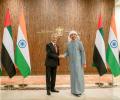
Frankly, was it really necessary in the middle of a fratricidal war for External Affairs Minister S Jaishankar to travel to Abu Dhabi for a one-on-one with the sheikh on April 12?Or, for National Security Advisor Ajit Doval to follow up on April 26? Or, for PM Narendra Modi to follow through today? There are no easy answers, notes Ambassador M K Bhadrakumar.

'Pakistan's is the only military-controlled nuclear weapons programme in the world.' 'As people get radicalised, the risk of a brigadier or pilot taking matters into their own hands is a real concern.'

As the March 31 deadline arrives, a wave of Maoist surrenders suggests insurgency's end, but political and social concerns remain.

Trump has made it clear: the US will not lift its blockade of Iranian ports until a deal is signed.

Prime Minister Narendra Modi will review the impact of the West Asia conflict on India's food, energy, and fuel security with senior cabinet ministers. The meeting follows previous discussions and concerns raised about global energy crises and supply chain disruptions.

A combination of security pressure and rehabilitation efforts has significantly weakened Naxalism in India, leading to numerous surrenders and the elimination of key leaders.

'We were in a heavily nuclearised environment. China had tested for Pakistan in the 1980s and helped their missile programme stay just one step behind us.'

The Americans can occupy Bab el Mandeb, claim to have 'solved' the Strait of Hormuz crisis, declare victory that President Trump so desperately needs, points out Colonel Anil A Athale, former head of the history division, ministry of defence.

The Indian embassy in Tehran has earlier stated that it is facilitating the safe movement of nationals who wish to leave Iran.
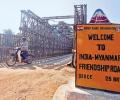
Security agencies in India are investigating a potential conspiracy involving arrested foreigners, including a US mercenary, who allegedly aimed to exploit Indian ethnic groups to undermine national security. The investigation involves data extraction from mobile phones and scrutiny of social media accounts to uncover the full extent of the plot and identify all involved parties.

India observed the first anniversary of the Pahalgam terror attack, with leaders paying homage to the victims and asserting the country's commitment to fighting terrorism.

Both sides have now revealed a preference for escalation over strategic defeat, and each new provocation narrows the space for the next pause. The Touska seizure, Iran's refusal to negotiate under blockade, Israel's strikes on Iranian oil infrastructure -- all of these add up to an increasingly untenable situation. This makes the wild card -- Trump and his motormouth -- more consequential than ever, notes Prem Panicker in his must read blog on the Iran War.
Records stretching back to 1947 suggest a consistent strategy by Pakistan's military and intelligence apparatus, the Inter Services Intelligence (ISI), of using terrorism as a state policy against India.

Nobody takes Pakistan seriously and therefore Pakistan's sudden mediating with almost immediate results of a ceasefire seems more contrived than real, points out Vice Admiral Biswajit Dasgupta (retd).

The Dhurandhar movies will undoubtedly shape the minds of the audience much more than news reports, court investigations, books and documentaries. But it is worth remembering that Pakistan's irridentist claims against India's national security have succeeded due to strategic planning, diplomacy, and the unsung heroines and heroes across government agencies, not due to a single maverick leader, points out Shweta Desai.But it is worth to remember that Pakistan's irredentist claims against India's national security have succeeded due to strategic planning, diplomacy, and the unsung heroines and heroes across government agencies -- not a single maverick, points out Shweta Desai.

India's handling of the Iran crisis reflects a growing strain between strategic autonomy and geopolitical alignment, observes Ambassador M K Bhadrakumar.

The delegations from the US and Iran head to Islamabad on Friday, carrying a ceasefire that is already fraying, a Strait that is technically open and practically closed, and a negotiating agenda that would challenge even parties actually negotiating in good faith, which these groups are not. Prem Panicker continues his must read blog on the Iran War.

Egypt, Pakistan, Saudi Arabia and Turkey met in Islamabad in what analysts say is the formal opening of a new diplomatic formation that could reshape the post-war regional order. Their immediate goal is a ceasefire; their larger ambition is to ensure that neither Iran nor Israel emerges from this war in a dominant position. Pakistan's foreign minister then flew directly to Beijing and mooted a Chinese role as guarantor of any eventual agreement. Prem Panicker continues his must read daily blog on the Gulf War.

The question is no longer whether the war will expand. It has. The next few days will tell us whether the war stabilises around Hormuz or whether the Strait itself becomes the trigger for a far larger rupture. What to watch for over the next 48 hours is simple: Any move by the US toward direct naval control of the Strait; any credible Iranian attempt to disrupt or mine shipping lanes and, critically, whether energy infrastructure in the Gulf continues to be targeted.If those lines are crossed in tandem, the war will no longer be containable within the region.
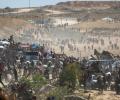
The recently signed Gaza Peace Agreement is a 'landmark' step towards stability in the Middle East, India has said, reiterating that a two-state solution remains 'the only pragmatic path' to achieving durable peace between Israel and Palestine.

'Torpedoes travel at more than 100 kilometres per hour, about 50-60 knots.' 'It must have been a matter of a few minutes before it detonated under the Iranian ship.' 'The Iranian ship would have probably got three, four minutes and wouldn't have known till they actually heard the whirr of the torpedo.'

'After the Galwan clash, the rules of engagement changed with the army commanders allowed to use any means at their disposal as they deem fit for tactical operations.'

This weekend, Donald Trump has begun to say the quiet part out loud -- that he wants to take control of Iran's oil, a formulation more in line with his robber-baron style of international relations.

The 'rescue' operation occurred within kilometres of Iran's underground tunnel complex at Isfahan, assessed by the IAEA and US intelligence as holding a substantial portion of the country's 60 per cent enriched uranium stockpile. Retired senior US military officers have highlighted that the mission's footprint -- hundreds of special operators, multiple heavy-lift aircraft deep inside Iran -- appears outsized for recovering a single airman. Prem Panicker continues his must read blog on the Iran War.

'The unexpected turn of events and assertion of sovereignty by the Taliban has baffled the Pakistan security establishment.'

Taking Kharg would give the US control over virtually all of Iran's oil exports and thus provide significant leverage, notes Prem Panicker in his must read daily blog on the Gulf War. It would also put American troops within range of Iran's remaining missiles, drones, and artillery on a piece of real estate that is just eight square miles in size, and just 15 miles from the Iranian mainland.

'We are profoundly energy-dependent on the Gulf. That dependency must now be redirected towards the United States, because we require American permission to procure oil.' 'We additionally require Iranian permission to acquire oil from that source. So India now has to seek two separate permissions merely to secure its energy supply.' 'Should we be compelled to source from America, or from Venezuela -- which is, in effect, American-controlled supply -- that will inevitably carry a price premium, an elevated shipping cost, and a considerably extended delivery timeline, given the distances involved.'

'The next two to three weeks will not be decided in Washington.' 'They will be decided in Tehran, in whatever calculation Iran makes about the costs of continued resistance against the costs of appearing to have yielded.'

When everyone has footage and no one can verify it, the loudest voice wins, notes Prem Panicker who begins a daily blog on the War in the Middle East.
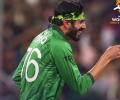
India's biggest challenge could come from an unexpected source -- Pakistan's mystery spinner Usman Tariq.

Fight on toward goals that keep receding, or exit with most objectives unmet. Trump is agitated, his poll numbers falling below the Plimsoll line, his base fractured between those who back the war and those who remember that he campaigned on ending them.

What we are watching is something different: A fog manufactured and maintained by the people who started the war, so that the question of why it was started never has to be answered, observes Prem Panicker in his must read blog on the war in the Middle East.

'Tarique Rahman's refrain during the electoral campaign was that the minorities are safe under BNP. He has to honour that promise.'

Days after Russia alleged that Ukraine targeted President Vladimir Putin's official residence in a drone attack, Russian authorities on Thursday said they had shared what they described as evidence related to the incident with the United States, Anadolu Agency reported.
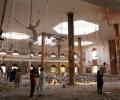
'Some success has been achieved in raising the costs of terrorism for Pakistan.'

'No, India and China were not about to go to all-out war over a few rocks of Galwan.' 'The full picture of what went on at the highest level between two heads of State will not be known for a very, very long time and rightly so,' points out Colonel Anil A Athale, former head of the history division, ministry of defence.

Nearly all of the nine nuclear-armed States, including India and Pakistan, continued intensive nuclear modernisation programmes in 2024, upgrading existing weapons and adding newer versions, according to a report by a global think-tank.
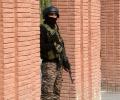
Authorities in Kashmir have initiated a profiling process of mosques, madrassas, and individuals associated with their management following the exposure of a 'white collar' terror module. The enumeration drive focuses on the finances of these institutions and the backgrounds of their personnel.

Indian strategic affairs experts criticize the US strike on Venezuela and the capture of President Nicolas Maduro, warning of a 'bad precedent' and potential for similar actions by other powers.

India emerged from the war militarily bruised and strategically altered. The United States, under the guise of friendship, had succeeded in achieving what open alignment never could: The psychological and political repositioning of India within the Cold War order, points out Dr Kumar.
